
The use of artificial intelligence in data analysis has changed how businesses get and use insights. It turns raw data into plans that can be acted on.
With predictive analytics, companies can make smart choices. They can guess market trends and stay ahead of rivals. This shift is key in our data-driven world.
Key Takeaways
- AI boosts data analysis skills.
- Predictive analytics guides business choices.
- Raw data becomes useful insights.
- Businesses can predict market trends.
- Data-driven plans help stay competitive.
The Evolution of Data Analysis in the AI Era
The AI era has changed data analysis in business. Before, companies used manual methods and spreadsheets. Now, AI has made data analysis more accurate and efficient.
From Traditional Analytics to AI-Powered Insights
Old analytics used static reports and manual data work. This was slow and often wrong. But AI has changed this, using machine learning for business to quickly and accurately analyze data.
AI tools can handle big data, find patterns, and predict trends. This has made data analysis more dynamic and forward-looking for businesses.
Key Drivers Behind AI Adoption in Data Analysis
Many things have led to AI’s use in data analysis. The data volume and complexity have grown, making old methods fail. Businesses also need faster and more accurate insights.
AI dashboards have made data analysis better. They offer a simple way to understand complex data. This has made AI and advanced visualization tools key in data analysis.
Understanding AI for Data Analysis
AI is key for businesses to stay ahead. It uses advanced data processing, machine learning, and natural language processing. This creates detailed reports and visuals from big datasets.
Core Technologies Powering AI Analytics
AI’s strength comes from its core technologies. These are machine learning, deep learning, and natural language processing. Deep learning and neural networks are crucial for finding complex patterns in data.
Deep Learning and Neural Networks
Deep learning uses neural networks to understand data. It’s vital for image and speech recognition, and predictive analytics. Deep learning models are layered to handle complex data analysis.
Reinforcement Learning Applications
Reinforcement learning lets AI learn by trial and error. It’s great for tasks like financial trading and resource allocation. AI models make decisions and optimize processes.
How AI Transforms the Data Analysis Workflow
AI changes data analysis by automating tasks, improving accuracy, and offering real-time insights. Automated reporting tools powered by AI create detailed reports and visuals without human help.
Let’s compare traditional data analysis with AI-driven data analysis:
| Aspect | Traditional Data Analysis | AI-Driven Data Analysis |
|---|---|---|
| Speed | Manual, time-consuming | Automated, rapid |
| Accuracy | Prone to human error | High accuracy, consistent |
| Insight Generation | Limited by human interpretation | Advanced pattern recognition |

Business Benefits of AI-Driven Data Analysis
AI in data analysis is changing how businesses work and plan. It helps companies find new insights and make smart choices.
Accelerating Decision-Making Processes
AI makes decisions faster by giving real-time insights. This lets businesses quickly adapt to market shifts and customer wants. Machine learning for business spots trends and chances.
Enhancing Accuracy and Reducing Human Error
AI cuts down on mistakes by doing data analysis tasks. This means better insights and choices. AI ensures businesses use exact data.
Scaling Analytics Capabilities
AI analytics can handle big data, growing with the business. This is key for companies with lots of data. The table below shows AI’s main benefits.
| Benefit | Description | Impact |
|---|---|---|
| Accelerated Decision-Making | Real-time insights | Quick response to market changes |
| Enhanced Accuracy | Minimized human error | Better decision-making |
| Scalability | Handling vast data amounts | Supports business growth |
By using AI for data analysis and machine learning for business, companies can greatly enhance their operations and planning.
Essential Machine Learning for Business Data Analysis
Businesses face big data challenges. Machine learning is a key tool for finding useful insights. It uses algorithms to learn from past data and predict future trends.
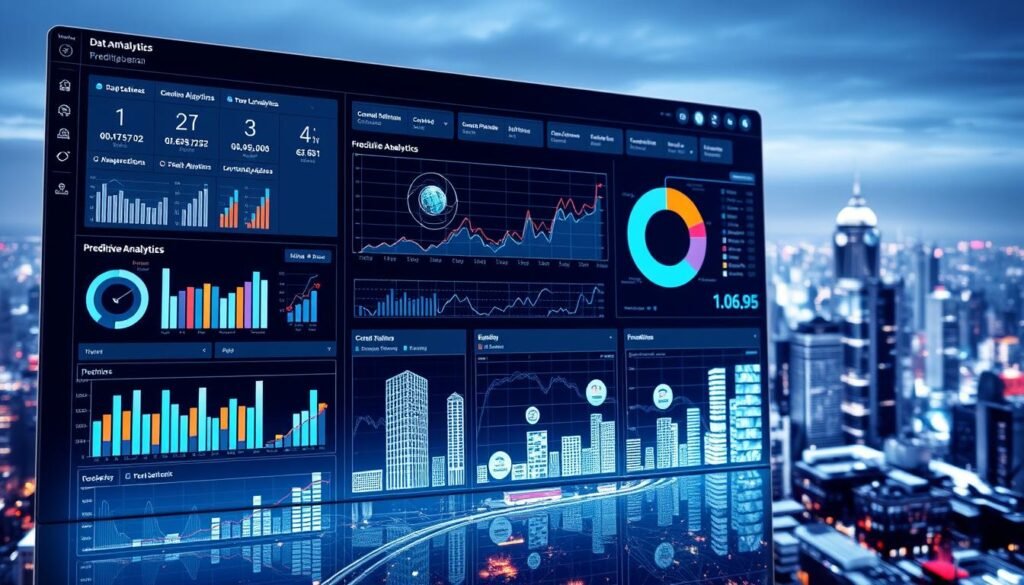
This skill is vital for using predictive analytics in business decisions. Machine learning helps find hidden trends and predict market changes. It also improves how businesses run.
Supervised Learning Techniques
Supervised learning trains algorithms on labeled data. It’s great for tasks like forecasting sales and identifying customer groups. It helps spot unusual patterns too.
Unsupervised Learning for Pattern Discovery
Unsupervised learning finds patterns in data without labels. It’s used for tasks like grouping similar customers and simplifying data. This helps find new opportunities.
Ensemble Methods for Improved Accuracy
Ensemble methods use many models to boost accuracy. They help avoid overfitting and make predictions more reliable. This is crucial for good predictive analytics.
Using these machine learning methods in automated reporting tools makes data analysis easier. Businesses can quickly adapt to market changes. They make decisions with more confidence.
Implementing Predictive Analytics with AI
AI-driven predictive analytics helps organizations make smart choices by predicting what’s next. It’s changing how businesses work in many fields. It gives them tools to get ready for new trends and challenges.
Building Effective Predictive Models
Predictive models are key to predictive analytics. They use past data and algorithms to guess what will happen next. How well a model works depends on the data quality and how it’s built.
Feature Selection and Engineering
Choosing and shaping features is crucial for predictive models. Feature selection picks the most important variables for the model’s power. Feature engineering then tweaks and mixes these variables to improve the model’s accuracy.
Model Training and Validation
After selecting and engineering features, the next step is training and validating the model. Model training uses past data to teach the model to predict. Validation checks if the model works well on new data, showing its reliability and accuracy.
From Prediction to Prescription: Taking Action on Insights
Predictive analytics is not just about predicting the future. It’s also about acting on those predictions. Businesses can use insights from predictive models to plan for opportunities or risks.
| Predictive Analytics Capabilities | Business Benefits | AI-Driven Advantages |
|---|---|---|
| Forecasting future trends | Informed decision-making | Enhanced accuracy |
| Identifying potential risks | Proactive risk management | Real-time insights |
| Optimizing business processes | Improved operational efficiency | Scalable analytics capabilities |
By using AI-driven predictive analytics, businesses can predict and act on future outcomes. This AI integration is changing how businesses operate. It makes them more proactive and adaptable to market changes.
AI Dashboards and Visualization Tools
AI-driven visualization tools are changing how we analyze data. They help businesses make better decisions. With AI for data analysis, companies can now create dashboards that are easy to use and show real-time insights.
Designing Intuitive AI-Powered Dashboards
Creating effective AI-powered dashboards is more than just showing data. It’s about making an experience that lets users dive deep into data. Key elements include:
- Customizable interfaces that meet different user needs
- Real-time data updates for quick decision-making
- Integration with various data sources for a full view
Real-Time Visualization Techniques
Real-time visualization is key for businesses that must act fast. Techniques include:
Interactive Data Exploration
This uses AI-driven tools to let users explore specific data points. They can analyze trends and find patterns easily, without needing to know a lot about tech.
Automated Insight Generation
Automated reporting tools can automatically find insights. They highlight important trends and oddities. This saves time and makes sure important info isn’t missed.

By using these techniques, businesses can improve their data analysis. This makes it easier to get useful insights from their data.
Automated Reporting Tools and Their Integration
Automated reporting tools, powered by AI, are changing how we analyze and report data. These tools make it easier for businesses to make quick, data-driven decisions.
Streamlining Report Generation with AI
AI in automated reporting tools makes report generation easier. AI algorithms can quickly process large datasets, find important trends, and present them clearly. This saves time and cuts down on mistakes.
Using AI for report generation has many benefits:
- Enhanced accuracy and reliability
- Faster report generation
- Customizable reporting templates
Connecting AI Insights to Business Workflows
It’s important to integrate AI insights into business workflows. This way, organizations can respond more effectively to changing market conditions and make better decisions.
| Business Workflow | AI Insight Integration | Benefit |
|---|---|---|
| Marketing Strategy | Predictive analytics for customer behavior | Targeted marketing campaigns |
| Supply Chain Management | Machine learning for demand forecasting | Optimized inventory management |
| Financial Planning | AI-driven financial forecasting | Data-driven financial decisions |
By using automated reporting tools and integrating AI insights, organizations can improve their predictive analytics. This leads to business success through machine learning for business applications.
Real-World Applications and Case Studies
AI is changing how we analyze data in many fields. It turns raw data into useful strategies. This section shows how AI is used in different areas.
Retail and E-commerce Analytics
In retail and e-commerce, AI is changing how we shop and manage supplies. AI dashboards help see what customers like and buy. This lets stores tailor ads, manage stock, and make customers happier.
Healthcare and Medical Data Analysis
AI is making healthcare better by improving patient care and making things run smoother. AI looks at medical data to spot trends and predict risks. Automated reporting tools make detailed patient reports fast, helping doctors make quick, smart choices.
Financial Services and Risk Assessment
In finance, AI helps spot risks and fraud. It checks transaction data for odd activities. AI-driven analytics help find risks accurately, keeping money safe and reducing losses.
These examples show AI’s wide use and impact in data analysis. As more businesses use AI-driven solutions, they can grow and make better choices. This leads to more innovation and success.
Conclusion
AI has changed how businesses get and use insights, leading to growth and new ideas. It helps companies find new chances and stay ahead.
Predictive analytics, a big part of AI, lets businesses see what’s coming and make smart choices. This is key in today’s fast world. Being able to guess and act on changes can really set you apart.
AI has made a big difference in areas like retail, healthcare, and finance. By using AI analytics, companies can make better choices, be more accurate, and come up with new ideas.
To keep up, businesses need to keep investing in AI for data analysis and predictive analytics. This way, they can use all their data to grow in a lasting way.